Peppy the Clown – The 1956 Arcade Machine That Sang for Your Dime
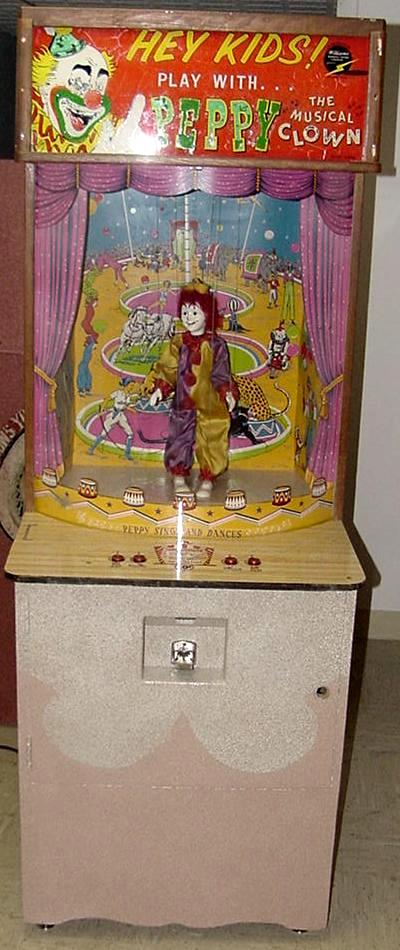
When we talk about arcade machines, we usually picture a flashing screen, a joystick, and the clatter of coins. Williams' Peppy the Clown, released in 1956, took a very different path: instead of an electronic display, a real, moving puppet waited inside it, on a tiny circus stage of its own.
You didn't shoot anything or chase a high score on this machine. Peppy simply sang and danced — and if that sounds like an odd thing to find in an arcade, it's worth seeing what was actually running the show behind the curtain.
A Puppet That Sang From a Tape
At the heart of the machine sat a Cousino-made quarter-inch endless-loop tape cartridge, driven by a vacuum-tube amplifier. On some tapes, conductive segments marked out how long each play lasted; on others, it was the silence between the songs that did the job. Traces of both methods survive on this model, as if the engineers themselves hadn't fully settled on one.
An integrator and a monostable circuit inside the amplifier kept the machine's run relay energized as long as no silence lasted longer than four seconds — fine-tuned with an external potentiometer. This was 1950s vacuum-tube electronics, built before the transistor era had really arrived.
Gallery
A Show for Kids, Ten Cents a Ticket
Peppy was built specifically for children. His head tilted from side to side as he sang along to calliope music, while players worked buttons on the front console to control his arm and leg movements. Drop in a dime, and Peppy put on a show — much the same idea United Billiards later carried forward in the 1970s with its Bimbo Three Ring Circus machine.
Nine Songs, and Only Pieces of Them Survive
Peppy originally shipped with nine songs, but no single collector today seems to hold all nine at once. Four turned up on one original tape; another five came from a separate collector — together, pieced from two different sources, they add up to the full set. Because the original Cousino tape player is fragile and long obsolete, today's restorers often swap it for a modern solid-state sound module that reproduces the same recordings far more reliably.
An Unexpected Detour Through Disneyland
One of the more surprising chapters in the machine's history comes from a former Disneyland arcade mechanic who worked there from 1997 to 2002. According to his account, Walt Disney Imagineering once bought two Peppy cabinets. One became "Hoofin' Henry," a dancing bear placed in the lobby of Country Bear Jamboree — later converted into a Toy Story-themed "Cowboy Woody" once that attraction closed. The other became a dancing Pinocchio game, reportedly still running today in the Main Street Penny Arcade.
Gallery
Bringing One Back From the Dead
Restoring an original Peppy is genuine detective work. The curved plexiglass front panel that once shielded him from curious hands is now often remade from Lexan, since it can be bent into shape during installation without cracking. Control panel graphics get rebuilt from a 300 DPI scan of an original decal and reprinted onto water-slide decal paper. And matching the cabinet's textured, stucco-like finish takes very specific textured spray paints to land close to the original 1950s look.
Peppy's Relatives
The arcade cabinet isn't the only form Peppy survived in. Collectors have also turned up an unopened, boxed Hazelle "Talking Marionette" tabletop toy called Peppy Clown — a sign that the character made it from the arcade floor all the way into family living rooms.
Source
This article draws on the write-up and photos published on pinrepair.com's Peppy the Clown page; the pictures shown here come from the site's owner and from a collector credited there as Will2614.