Genie
Quick Overview
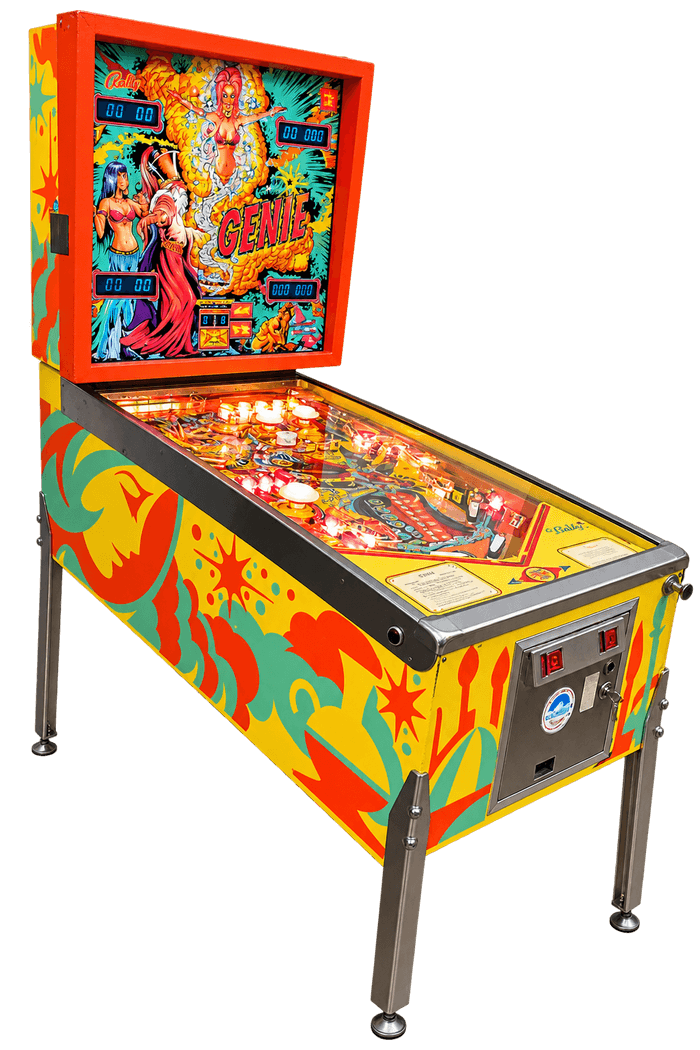
Genie is one of Gottlieb's truly spectacular pinball machines from the late 1970s. Its size alone stands out: it comes in a wide-body cabinet — wider than a standard pinball machine — housing a massive playfield packed with targets. The machine's fantasy world is populated by genies, wizards, and exotic figures. Gordon Morison's richly detailed artwork combined with the unusually large playfield make Genie one of the most recognizable machines of the Gottlieb System 1 era.
Basics
- Release1979
- ManufacturerD. Gottlieb & Co.
- DesignerEd Krynski
- ArtGordon Morison
- SystemGottlieb System 1
- GenrePinball
- Players1–4
- FormatWide-body
- Flippers5
- Bumpers3
- Drop targets11
- Multiballnone
- Units produced6,800
Creators
Standout features:
Play It Live!
Rub the lamp — instead of three wishes, you get five flippers. Try the 1979 Gottlieb Genie pinball machine in person at Arcade Museum Budapest.
Insert CoinGame Objective
Genie is all about classic pinball: precise shots, drop targets to knock down, bonuses, and as high a score as possible. The massive playfield holds 11 drop targets, three bumpers, a spinner, and numerous scoring targets. Five flippers help you reach the playfield's different areas. Unlike modern machines, there are no long quests, video scenes, or multiball here. Genie's challenge comes from the sheer size of the playfield itself and controlling the ball. It sounds simple — but a good score demands quick reactions and precise shots.
Fun Facts
- Genie has a wide-body cabinet and playfield — wider than the standard size.
- The machine has five flippers in total.
- The playfield holds 11 drop targets waiting to be knocked down.
- Genie belongs to the Gottlieb System 1 generation of electronic pinball machines.
- The game already uses digital scoring displays.
- It was designed by Ed Krynski, who worked on many of Gottlieb's classic pinball machines.
- The striking fantasy artwork was created by Gordon Morison.
- The machine's sound system was highlighted in period advertising materials as "Multi-Mode Sound."
- Genie has no multiball — the entire game is built around precisely controlling a single ball.
- A total of 6,800 units were produced.
Why Is It Special?
With Genie, the first surprise is simply its size. The wide cabinet and massive playfield make it feel far roomier than an average 1970s pinball machine. The ball travels long distances while you work the five flippers across the playfield's different areas. Then there's Gordon Morison's unmistakable fantasy artwork: genies, wizards, and vivid colors cover the cabinet, the backglass, and the playfield. Genie comes from an era that didn't try to hold the player's attention with videos and elaborate storylines. You get one ball, five flippers, and a massive playfield. The rest is up to you.